
May 8, 2026 · ReelMap Team
Japan is the #1 travel destination right now. TikTok is why — and why your itinerary is still a mess.
Japan welcomed a record 42.7 million international visitors in 2025. A huge percentage of them planned their trip from short-form video. Here's what that looks like in practice, and how to build an actual itinerary from it.
Last updated: May 15, 2026
Japan welcomed a record 42.7 million international visitors in 2025 — a 15.8% jump from the previous high of 36.9 million in 2024, according to the Japan National Tourism Organization. For context: that's the entire population of California showing up in a country the size of Montana, inside twelve months. The government is talking about tourist caps. Certain spots in Kyoto are physically fenced off.
And yet the content keeps coming. Tokyo ramen alleys. Osaka street food. Kyushu hot springs nobody in the West has heard of. Shikoku, Kanazawa, Hakone, the izakaya under the train tracks in Yurakucho. TikTok has become the world's best travel discovery machine, and Japan is its most filmed subject.
The problem is a travel discovery machine is not a travel planning tool. They are different things.
Why Japan specifically breaks the saved-video model
Most destinations have a loose geographic logic that makes video-based planning manageable. "Paris food spots" means you're broadly operating in a city where everything is within 30 minutes of everything else.
Japan doesn't work that way. A creator might post a video that covers:
- A ramen shop in Shinjuku
- A conveyor belt sushi place in Shibuya
- A tea house in Yanaka
- A 7-Eleven hack best used at Haneda Airport on arrival
- A viewpoint that's actually in Nikko, two hours north of Tokyo
All of this is labeled "Tokyo must-visit." All of it is in the same saved folder. None of it is on a map.
Multiply this by 30 saved videos and you have the Japan itinerary planning experience that most people have: a vague sense of many excellent places with no understanding of how they connect geographically or what is actually achievable in a two-week trip.
The 2026 Japan travel shift
Something changed this year in how people are thinking about Japan trips. The conversation has moved beyond the standard Tokyo-Kyoto-Osaka Golden Route.
Repeat visitors — and Japan is seeing enormous repeat visitation — are specifically looking for what the guidebooks haven't caught up to yet. Fukuoka for its street-level food culture. The Noto Peninsula after reconstruction. Kyushu's coastal routes. Smaller cities in Tohoku. All of this is already on TikTok, posted by local creators and international visitors who went beyond the main cities.
The irony is that this content is harder to act on, not easier. A video from a creator exploring a side street in Fukuoka's Tenjin neighborhood might contain the best food recommendation you'll get for the whole trip — but if you can't identify the restaurant, you can't get there.
What actually works for Japan trip planning from social media
Here's the workflow that produces a usable itinerary:
Start with geography, not content. Before you start watching videos, decide your cities and your rough day allocation. Two weeks in Japan might look like: Tokyo (5 days), day trips from Tokyo (Nikko, Kamakura — 2 days), Hakone (1 night), Kyoto (3 days), Osaka (2 days), Nara day trip (1 day), Fukuoka (2 days). That structure exists before you've watched a single video.
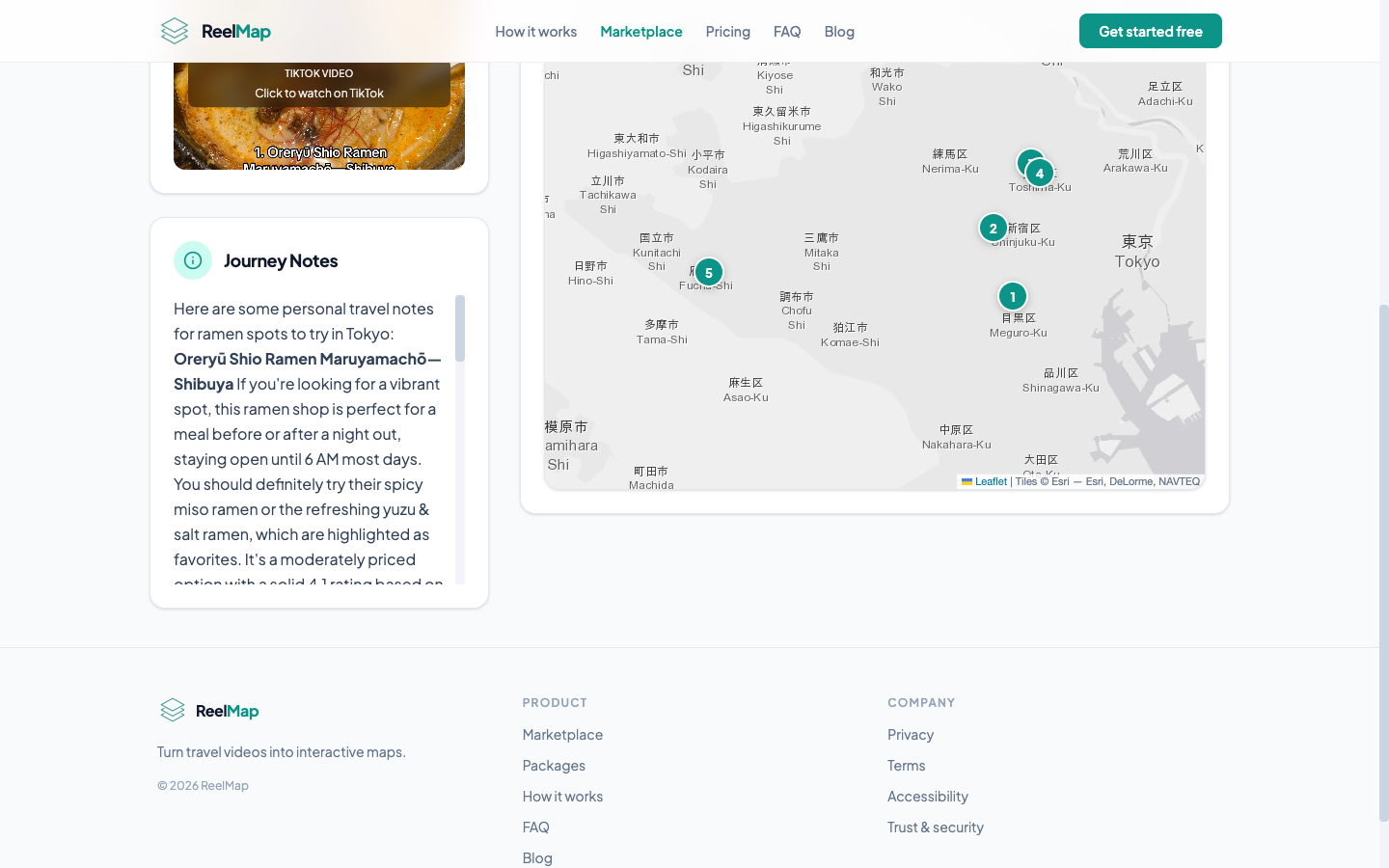
Watch and extract by city. For each city in your plan, pull the saved videos and paste them into ReelMap. The AI extracts every identifiable place — restaurant names, landmarks, temples, bars — and plots them on a map. For a dense Tokyo food video with 8 named spots, this takes about 30 seconds.
Review the map before committing to anything. A pinned map for Osaka might show you that half your saved spots are in Dotonbori, one is in Shinsekai 20 minutes south, and one is actually in Namba — which is the same district as Dotonbori, just a different street. This clustering is invisible in a list. On a map it becomes a half-day in a neighborhood.
Cross-check opening days and queues. Japan has a specific closure pattern that trips up first-timers: many beloved restaurants close Monday and Tuesday. Ramen shops that went viral often have 45-minute weekday queues and 90-minute weekend queues. Checking before you anchor a day around a spot is worth 60 seconds.
The konbini stop isn't optional
One thing TikTok got genuinely right about Japan travel: the convenience stores are worth your time. Not as a backup when nothing else is open — as a destination in themselves.
7-Eleven, Lawson, and FamilyMart in Japan operate at a different altitude than their Western equivalents. Onigiri with seasonal fillings, hot prepared food at 11pm, regional limited editions that rotate monthly, matcha everything, egg salad sandwiches that have a genuine following. A meaningful portion of 2026 Japan travel content on TikTok is just people inside a Lawson at midnight.
You can't really "map" a konbini crawl — they're everywhere — but you can use the haul videos to know what to look for when you walk in. Save a few of the better ones; the payoff is actually there.
Hidden Japan: what the algorithm finds first
The best thing TikTok has done for Japan travel is surface places that operate on 0 marketing budget and 100% reputation. A tiny tonkatsu counter in a Kyoto shotengai that seats 8. A jazz bar in Shimokitazawa that's been there since 1978. A public bath in Beppu that costs ¥350 and has a view of the harbor.
These places exist in the videos. The obstacle is extracting them — because creators often don't include the name in the caption, and the shop sign is either in kanji or obscured. When the name does appear (on screen, in audio, in the creator's text overlay), ReelMap pulls it. When it doesn't, no tool can guess it from footage alone.
The practical implication: save videos where creators actually name places, not just vibes videos. The best Japan content is the creator who walks you through six restaurants and tells you the name, the order, and the approximate price of every one. That video, run through ReelMap, becomes a map you can use the day you land.
Japan rewards preparation more than almost any destination — not because it's difficult, but because the density of good things per square kilometer is so high that showing up without a map means leaving most of them behind.
Start building your Japan map — paste any travel video and see the spots extracted in seconds.
Related reading:
- Tokyo food TikTok to map — deep dive on Tokyo's food scene specifically: ramen, izakaya alleys, the viral spots worth the queue.
- Osaka's food scene from Instagram Reels — the Osaka-specific guide: Dotonbori, Shinsekai, and why the food geography matters.
- How to plan a trip from Instagram Reels — the planning framework that applies to any destination.