
May 8, 2026 · ReelMap Team
Tokyo food TikTok is a rabbit hole. Here's how to turn it into a map.
You've saved 40 Tokyo food videos. Ramen shops in Shinjuku, izakaya alleys in Yurakucho, crème brûlée donuts from that cart in Harajuku. Here's how to get all of it onto one map before you land.
Tokyo food TikTok is its own genre. Thirty-second clips of noodles being pulled, broth being poured, egg yolks breaking over rice. Someone wanders into a basement ramen counter in Shinjuku with 12 seats and a 45-minute queue and now 4 million people have saved the video.
You are one of those 4 million people.
The problem isn't finding Tokyo food content. The problem is that you've now got 40 saved videos, you're flying in three weeks, and the spots are scattered across bookmarks, screenshots, a Notes app draft, and three different "Tokyo 2026" lists you started on different days.
That's what this post is about.
Why Tokyo food specifically goes viral
Tokyo has more Michelin-starred restaurants than any other city on earth — but the content that actually goes viral isn't the tasting menus. It's:
-
The ramen spots with visual presentation. Kipposhi in Shibuya made the algorithm lose its mind with colored broth. Fuunji in Shinjuku has a tsukemen dipping bowl that photographs like concept art. These places were already beloved by Tokyo residents; TikTok just made the queues 40 minutes longer.
-
The izakaya alleys. Yurakucho under the train tracks. Omoide Yokocho in Shinjuku. Hoppy Street in Asakusa. The combination of atmosphere and cheap, perfect food is crack for the camera.
-
The basement and back-alley finds. Tokyo has a whole architecture of hidden floors: basement restaurant floors (B1, B2, sometimes B3) and upper floors (3F, 4F) that street-level signage barely acknowledges. A creator who knows the city will take you places that don't have a visible entrance from the street.
-
The crème brûlée donut and the konbini haul. Viral food moments that don't require a reservation — you just show up, or walk into a 7-Eleven and buy a triangular sandwich.
All of this is real and worth pursuing. The issue is logistics.
The problem with saving Tokyo food videos
The TikTok bookmarks folder for a Tokyo trip looks like this by departure week:
- 12 ramen videos (three are the same shop shot by different creators)
- 8 izakaya clips (no indication of which ward they're in)
- 4 "hidden gem" videos where the creator didn't caption the location and the shop sign is in kanji
- 2 videos of the same conveyor belt sushi chain
- 1 video of a park that isn't food but you saved it anyway
- Unknown number of FamilyMart and Lawson hauls
Finding these when you're standing in Shinjuku at 7pm, jet-lagged and hungry, is essentially impossible.
Building the map
The approach that works:
1. Batch your saved videos by city first. Tokyo, Osaka, Kyoto, Fukuoka — separate sessions. Tokyo alone generates enough content for multiple day-blocks.
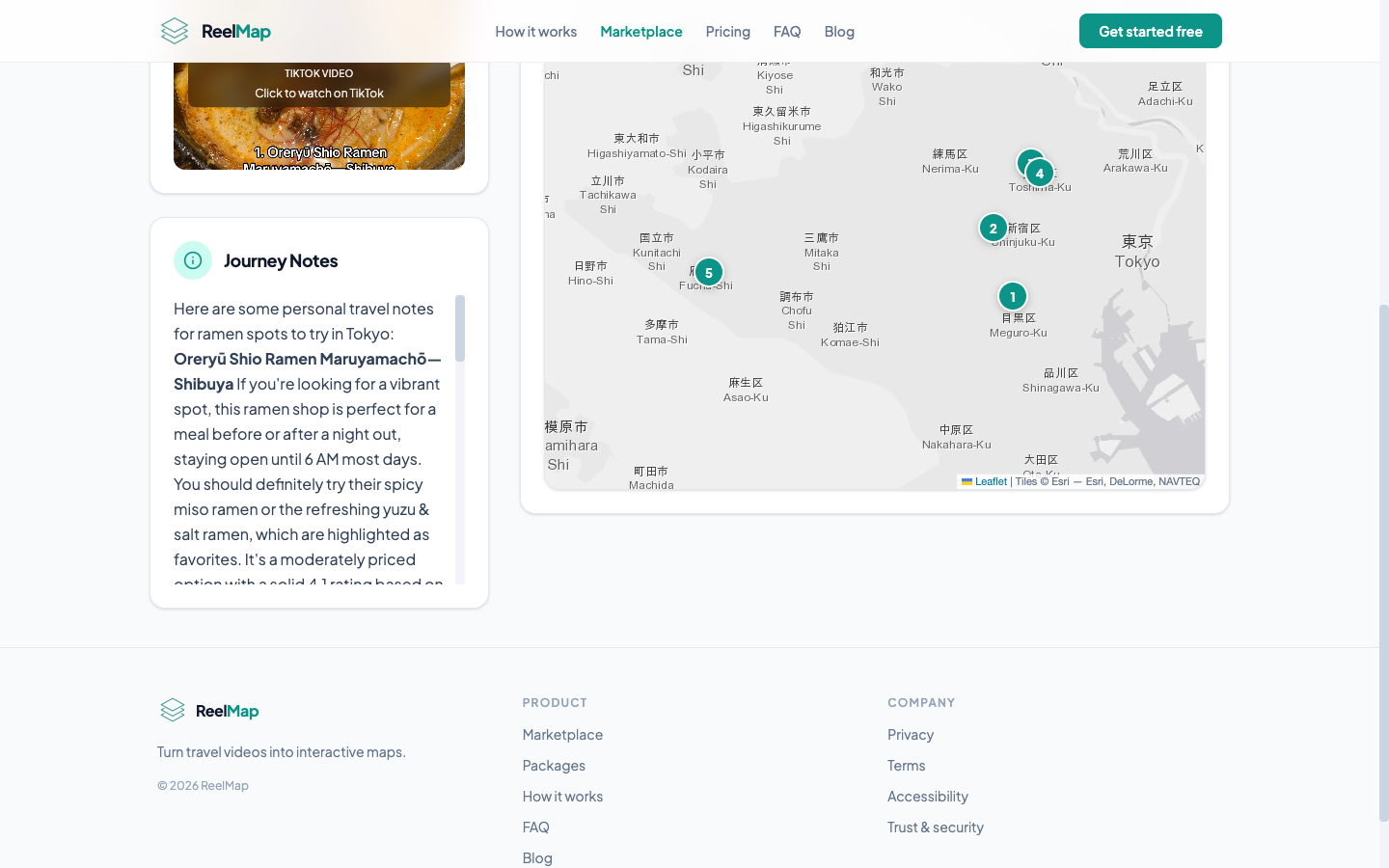
2. Paste each URL into ReelMap. The AI watches the video, listens to the audio (Japanese narration, English voiceover, whatever's there), reads any on-screen text or location tags, and pulls out every identifiable place. For a well-made Tokyo food video — one where the creator names spots, shows address overlays, or tags locations — you get a full pinned map in under 30 seconds.
3. Review the map by ward. Tokyo is big. Shinjuku, Shibuya, Asakusa, Ginza, Yanaka, Shimokitazawa — these are all different days. A ramen spot in Ikebukuro and an izakaya in Yurakucho are an hour apart on foot. Group by ward before you plan.
4. Drop duplicates. Three creators shooting the same trending ramen shop means three identical pins. The chain deduplication is automatic in ReelMap; creator duplicates you handle manually by keeping the most detailed entry.
What to do with the map once it exists
A complete Tokyo food map with 60 pins is still overwhelming. Prune to 8–10 per day-block:
- One anchor spot per session — the place you'd actually be sad to miss. Book it if it takes reservations; queue for it if it doesn't.
- Two or three backup options nearby — for when the anchor has a 90-minute wait at 7pm on a Saturday.
- Let the rest be ambient. Having the pin in the map means you can pull it up if you happen to be in that ward. It doesn't need to be a scheduled stop.
The single most useful thing you can do for a Tokyo food trip is know which ward you're eating in that day. The best meal you'll have will probably be somewhere you stumbled into because you were already in the neighborhood.
What the algorithm leaves out
TikTok is very good at surfacing the cinematic and the viral. It is not great at surfacing context:
- Hours and last-order times. Japanese restaurants often have strict last-order policies. The ramen shop that looks open at 9pm might stop seating at 8:30.
- Queue reality. A "hidden gem" that went viral six months ago now has a 90-minute wait on weekends. Some are worth it; some have better, quieter alternatives two streets over.
- Seasonal availability. Limited edition ramen collaborations, seasonal ingredients, pop-ups that ran in February 2026 — a lot of viral food content is time-bound.
ReelMap extracts what's in the video. Whether the place still matches the video is a quick Google Maps check on the ones you're most excited about.
Paste your first Tokyo food video and see what comes out. The map builds faster than the itinerary.
Related reading:
- Japan travel planning from TikTok 2026 — the full Japan strategy, from Tokyo to Osaka to the places the algorithm hasn't found yet.
- Osaka's food scene from Instagram Reels — same approach, different city, completely different food culture.
- How to save TikTok travel spots — the general-purpose guide to the saved-videos problem.